Pachisi is a very ancient Indian game for 4 people playing in 2 pairs, also known as "Twenty Five". This is the original game from which Ludo and Parcheesi were derived, although you will see that the rules are different. Pachisi is quite a skillful game, where you must definitely play as a partnership to win. Scroll down for instructions and our printable game board below.
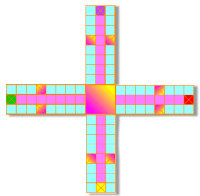
You will need:
- One game board, printed and assembled
- 16 pieces, printed and assembled
- A set of 6 small cowrie shells, or 6 coins adapted as shown on the printout
- Our pachisi game board printable
Preparation:
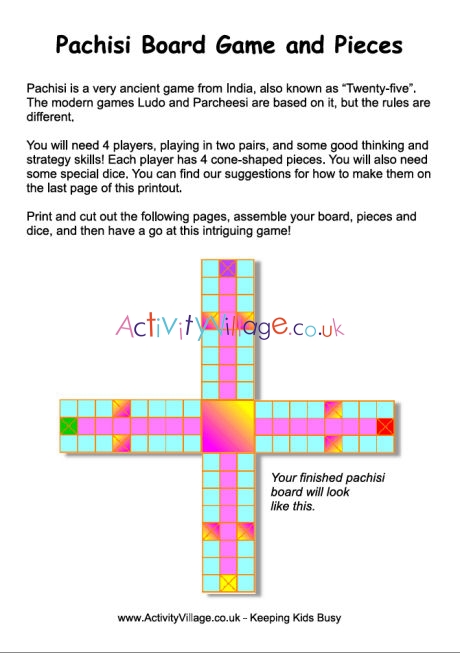
Choose a partner, and sit opposite them with the board between you. Take the 4 pieces which match the colour at the end of the arm pointing to you. This means that Purple and Yellow will be playing against Red and Green. Put all the pieces in the centre square (known as Charkoni, but which we will call Centre from now on). Lay the scoring chart on the table near the board for reference, until you get used to the scoring.
Now throw your "dice" and decide who starts: the player with the highest score begins and then play follows around the table in an anti-clockwise direction.
The Aim of the Game:
The first team to move all their pieces out of Centre, around the board, and back to Centre, are the winners.
How To Play Pachisi:
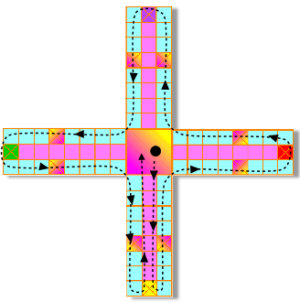
The first player throws the "dice" and moves one of his pieces out of Centre, down the pink column of the board nearest him and marked by his colour, and then around the board as shown by the arrows below. If one of the special "Grace" numbers is thrown (25 points, 10 points or 6 points), the player is allowed another turn as long as he or she removes a second piece from Centre. Play then passes to the right.
On each player's first throw they are allowed to take one of their pieces out of Centre, no matter what they throw. But for subsequent turns, they need to throw a Grace to be able to take a piece out.
You can land on the same square as one of your partner's pieces.
You can land on any empty Castle (marked by a yellow cross).
You cannot land on a Castle that is occupied by one of your opponent's pieces. If that is your only possible move, you miss your turn.
Capturing:
If you land on a square occupied by one of your opponent's pieces, you can capture their piece and send it back to Centre! You then take another turn. Remember that their piece will not be allowed out of Centre again until they throw a Grace.
Choosing Not To Move:
When you have thrown the "dice", you may decide not to take your turn (perhaps because it would be safer to stay on a Castle, or to help your partner.
Moving Back To Centre:
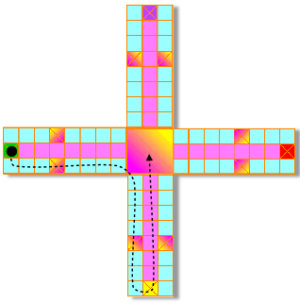
To win, you and your partner need to get all your pieces around the board and back into the Centre. However, you need to throw an exact number to return to the Centre, so it isn't always easy! Hint: if you land on the Castle Square at the end of the arm to your left, you can sit there and wait for the perfect throw - 25 points - to jump straight back to Centre. See the illustration below.
When your piece has been all the way around the board and reaches Centre again, turn it on its side to show that it has completed its round.
You don't have to return to Centre: sometimes, if your partner is very far behind, it may be more helpful for you to go all the way around the board again!